
Arhiv / 2026.05.06.
Szabó Virág: About the “Dragon’s Eye” Performance of the Csokonai Nemzeti Színház in Debrecen
How old were you the last time you truly let your imagination run free? I do not mean daydreaming, nor dreams themselves, but that liberating state in which you allow everything, when you believe that anything can happen, no matter how surreal it may seem. When the flow of thoughts is unrestricted by limits or rationality, when you give them complete freedom and simply drift along with them…
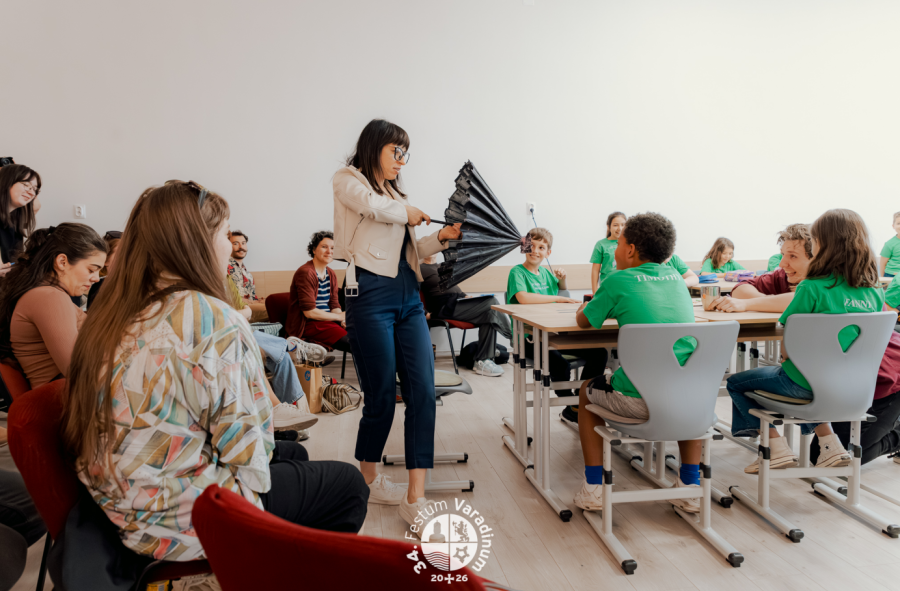
We had the opportunity to see the performance Sárkányszem (Dragon’s Eyes), directed by Bethlenfalvy Ádám and presented by the Csokonai Nemzeti Színház, as part of the 14th Holnapután Fesztivál, together with one of the third-grade classes of the Lorántffy Zsuzsanna Reformed High School. The interactive performance, built around the active involvement of children, not only opened pathways for their creativity but also touched upon several important themes and questions, such as fear, absence, rejection, disappointment, and the differences between looking and truly seeing.
The two actors, Madák Zsuzsanna and Bolla Bence, were already waiting for the children in the classroom. Once everyone had taken their seats around the desks pushed together, the actors introduced themselves and prepared the children for what was about to happen: they would step outside for a moment and return in the roles of two teachers, Aunt Klára and Uncle Miklós. Uncle Miklós was there to give a demonstration lesson, while Aunt Klára acted as the evaluating teacher. The subject of the class was the eye. The eye, vision, looking, and imagination.
The strict Aunt Klára does not understand Uncle Miklós’s innovative and wide-ranging teaching methods, yet despite the tension between them, she often becomes his partner in carrying out the games and exercises. Following several imagination-stimulating activities, Uncle Miklós begins telling the story of a little Chinese boy, written for the performance by Hajós Eszter. However, the story is unfinished, and together with the students they shape the adventurous journey of the young protagonist.
How does all this connect to the topic of the lesson? We do not see with our eyes, but with our brains — and with our minds we can see anything we wish. Thanks to this, anything can happen in the story if it is born in our imagination. The difference between physical sight and the “inner eye” was illustrated through engaging and imaginative exercises.
And how did the many themes of this unconventional “lesson” speak to the adults observing quietly in the background? For a little while, we too were able to become children again, returning to the limitless and carefree world of play, feeling liberated and reliving the enthusiasm of childhood.
Szabó Virág is a first-year theatre studies student at Babeș-Bolyai University.